
This is a very comprehensive and beautiful Quranic dua mentioned in verse 201 of Surah Al-Baqarah. This dua encompasses all the good things of this world and the hereafter.
The supplications of the Holy Quran that Allah Almighty Himself taught His servants are unparalleled in terms of meaning and effectiveness. One of the greatest supplications is “Our Lord, give us in this world good and in the Hereafter good and save us from the punishment of the Fire”.
Below is a detailed article containing a complete explanation of this dua and its virtues.
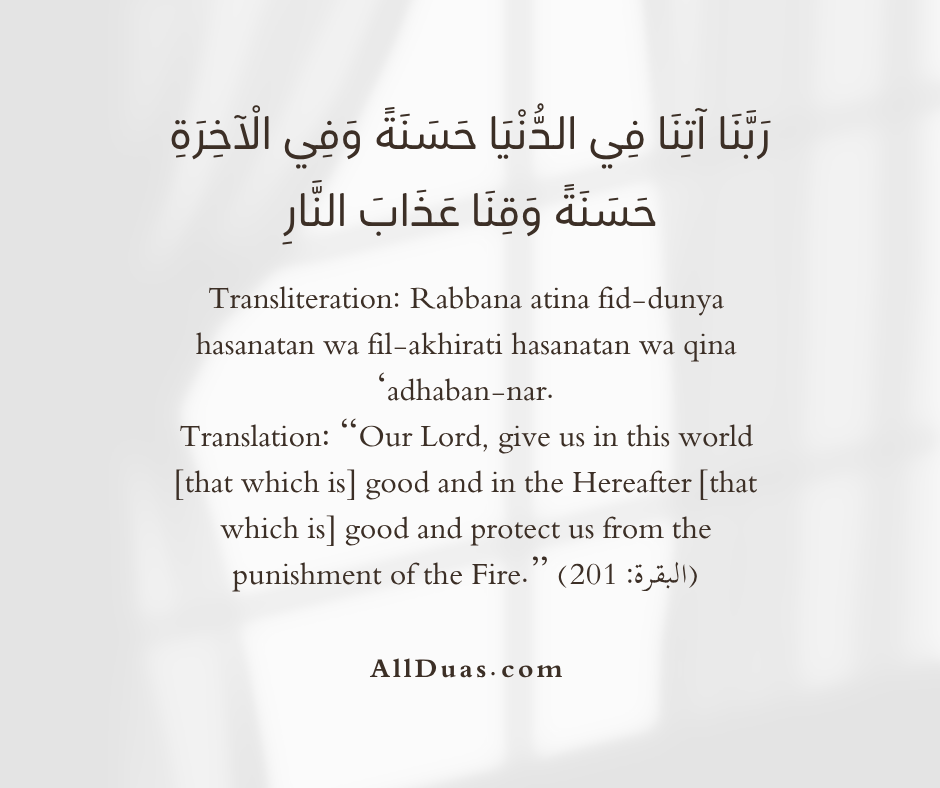
رَبَّنَا آتِنَا فِي الدُّنْيَا حَسَنَةً وَفِي الْآخِرَةِ حَسَنَةً وَقِنَا عَذَابَ النَّارِ
Transliteration: Rabbana atina fid-dunya hasanatan wa fil-akhirati hasanatan wa qina ‘adhaban-nar.
Translation: “Our Lord, give us in this world [that which is] good and in the Hereafter [that which is] good and protect us from the punishment of the Fire.” (البقرة: 201)
Background and Context of Dua
This supplication is part of verse number 201 of Surah Al-Baqarah. The time of its revelation was during the Hajj, when people gathered in Mecca. In the pre-Islamic era of ignorance, when people finished the rituals of Hajj and stayed in the plains of Mina, they would supplicate to Allah there. But the focus of their supplications was solely on worldly interests.
They would say to Allah: “O Allah! Send abundant rain this year, may our crops be good, grant us wealth and power and grant us victory over our enemies.” In their entire supplication, there was no mention of the Hereafter, forgiveness or Paradise.
Comparison and Correction of the Quran
Allah Almighty described this attitude of these people in the Holy Quran:
فَمِنَ النَّاسِ مَنْ يَقُولُ رَبَّنَا آتِنَا فِي الدُّنْيَا وَمَا لَهُ فِي الْآخِرَةِ مِنْ خَلَاقٍ
Surah Al-Baqarah (2:200)
Then among the people is he who says, “Our Lord! Give us (everything) in this world, but he has no share in the Hereafter.”
Immediately after this, Allah Almighty mentioned those believers who had sound reason and whose supplications Allah accepted. Allah explained that a believer is one who is not confined to the narrow sphere of this world, but rather has a broad vision.
If you study verses 200 to 202 of Surah Al-Baqarah, the context becomes very clear:
- Verse 200: Allah has commanded that when you have completed the pillars of Hajj, then remember Allah as you used to remember your fathers, or even more.
- Verse 201: Here the great supplication is mentioned that there are some people who ask for the good (hasanah) of both this world and the Hereafter.
- Verse 202: Allah has given them the good news that they will have a share of their earnings (deeds and supplications) and that Allah is swift in taking account.
The background of this dua teaches us that Islam is a path of “moderation” between (complete abandonment of the world) and (being only of the world).
Allah did not say not to ask for the world, but rather taught that along with the world, one should also ask for the Hereafter. The success of a Muslim is that he prays for his economy, health, and family (the world), but never forgets his eternal life (the Hereafter).
The Favorite Dua of the Messenger of Allah (ﷺ)
A study of the blessed life of the Prophet Muhammad (ﷺ) shows that he used to supplicate to Allah Almighty very frequently. He loved this supplication more than all other supplications.
Here are some important points regarding the virtue of this dua:
Recite this Frequently
Hazrat Anas bin Malik (RA), who was the special servant of the Messenger of Allah (ﷺ), says:
“The supplication that the Messenger of Allah (ﷺ) used to supplicate the most is: رَبَّنَا آتِنَا فِي الدُّنْيَا حَسَنَةً وَفِي الْآخِرَةِ حَسَنَةً وَقِنَا عَذَابَ النَّارِ” (Sahih Bukhari and Sahih Muslim).
Since Hazrat Anas (ﷺ) lived with him for ten years, his testimony shows the importance of this supplication.
The Comprehensiveness of Dua
The Messenger of Allah (ﷺ) was given the miracle of “Jawamee’ al-Kalam” (saying great things in few words). Instead of long and elaborate supplications, he preferred such duas that were short but contained all the good of this world and the Hereafter. This supplication is the best example of that.
Advice to the Companions
Once the Messenger of Allah (ﷺ) went to visit a companion who had become very weak due to illness. He (ﷺ) asked him, “Do you ask Allah for any special prayer?” He replied, “I say, ‘O Allah! Whatever punishment You have for me in the Hereafter, give it to me in this world.’”
He (ﷺ) recited Subhan Allah and said, “You do not have the power to do that. Why did you not say: ‘Rabbana atina fid-dunya hasanatan wa fil-akhirati hasanatan wa qina ‘adhaban-nar.’” Then he (ﷺ) prayed for him and he recovered. (Sahih Muslim)
Special Dua for Tawaf-e-Kaaba
When the Holy Prophet (ﷺ) circumambulated the Kaaba, he used to recite this dua especially between the “Rukn-e-Yamani” and the “Hajar-e-Aswad”. Even today, millions of pilgrims recite this dua during the Tawaf following this Sunnah.
An Essential Part of Every Dua
Imam Tabari (RA) narrates that whenever the predecessors (religious elders) and the Holy Prophet (ﷺ) himself made a dua, he would definitely include this dua at the beginning or end of it so that if there was a question about a specific need, then with the blessings of this dua, it would also be fulfilled in the category of “Hasana” (goodness).
Importance of Rabbana Atina Fid Dunya
Today is the era of materialism. People are either running after money or escaping from worldly responsibilities in the name of religion. “Rabbana Atina” teaches us moderation.
It is not wrong to ask for a good car, a good house and a good life. But the aim of all these should be for the betterment of the hereafter. Investment should not be only in bank balance, but also in righteous deeds.
Conclusion
“رَبَّنَا آتِنَا فِي الدُّنْيَا حَسَنَةً وَفِي الْآخِرَةِ حَسَنَةً وَقِنَا عَذَابَ النَّارِ” is not just a collection of words, but a complete way of life. It teaches us that every action in our life should be in such a way that it makes our world better and the eternal journey to the Hereafter peaceful.
We should make this dua a part of our lives. Recite it after prayers, while walking, and especially in moments of distress. This dua attracts the mercy of Allah and creates blessings in life.
We pray that Allah Almighty will grant us all the true goodness of this world, illuminate our Hereafter, and protect us from the torment of Hell. Amen.